Precision In-Mold Automation & Control Equipment for Hanoi Factories
Engineered to deliver high cycle rates, sub-micron repeatability, and seamless integration into automated injection cells across Bac Ninh, Hai Phong, and Hanoi industrial parks.
Hanoi's Manufacturing Shift Toward In-Mold Automation
The Greater Hanoi industrial corridor—including Bac Ninh, Vinh Phuc, and Thai Nguyen—has transformed into Southeast Asia’s most concentrated epicenter for consumer electronics, automotive parts, and high-precision plastic components. Global OEMs and Tier-1 suppliers are operating at scale, where conventional post-mold processing no longer meets output velocity and quality standards.
Traditional secondary degating introduces labor overhead, particulate contamination, and microscopic shear marks that disrupt zero-defect quality mandates. Integrating automation solution systems directly within the mold enables gate-cutting, core pull, and hole perforation during the closed-mold cycle prior to ejection. This cuts cycle times by 15% to 35% and completely removes manual handling from the production floor.
Zero Secondary Degating
Cuts runners and gates cleanly inside the mold while parts are still thermo-plasticized, eliminating manual trimming.
Surface Integrity
Maintains Ra 0.05–0.2 μm mirror surface finish on optical and acoustic bezels without gate vestige or stress marks.
Cycle Optimization
Reclaims 2.5 to 6.8 seconds per cycle on multi-cavity precision tools running 24/7 in Hanoi production plants.
Closed-Loop Control
High-pressure hydraulic/pneumatic sequencing synchronizes with injection molding machine signals down to 1 ms.
Engineering Precision from Taoyuan, Scalable Delivery from Southern China
Combining Taiwanese precision tooling heritage with South China's high-capacity manufacturing supply chains to serve Hanoi's export-oriented mold builders.
Sub-Micron Machining Tolerances
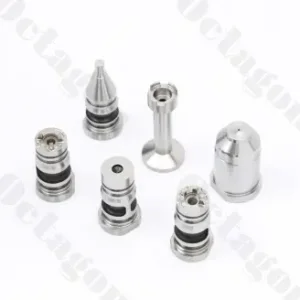
Every core insert, slide, and gate-cutting blade is machined to within ±0.002 mm. Utilizing Sodick wire EDM and Makino high-speed CNC centers, we guarantee interchangeability for high-cavity tools deployed in Vietnam.
Economies of Scale & Fast Freight
Direct logistical corridors between Shenzhen/Dongguan and Hanoi allow 24- to 48-hour delivery of precision tooling components, replacement pneumatic cylinders, and wire harnesses via land or air express networks.
End-to-End ODM Co-Development
Our senior engineers review mold drawings, injection pressures, resin shrinkage rates, and gating layouts before cutting steel. We adapt timing logic, valve sizing, and booster ratios directly to your part geometry.
Localized In-Mold Automation Applications in Northern Vietnam
Targeted solutions developed for specific manufacturing verticals operating inside Vietnam's key export processing zones.
Electronics & Acoustic Housings
Deployment: Bac Ninh & Thai Nguyen OEM hubs.
Challenge: TWS earbud cases, smartphone bezels, and tablet frames require zero surface blemishes and clean optical edges.
Solution: In-mold degating units with integrated micro-stroke cylinders that sever side and pin gates during mold opening deceleration, yielding clean fracture planes without stress whitening.
Automotive & EV Interior Modules
Deployment: Hai Phong & Vinh Phuc automotive corridors.
Challenge: Glass-filled nylon and engineering resins cause rapid wear on cutting tools and require high cutting forces (up to 5,000 kgf).
Solution: High-pressure gas-liquid booster systems driving tungsten carbide-tipped cutting blades timed precisely at the packing phase to prevent flash and dimensional drift.
Medical Diagnostics & Fluidics
Deployment: Cleanroom injection facilities around Hanoi.
Challenge: Syringe barrels, microfluidic plates, and IV connector molds require zero human intervention to satisfy ISO 13485 hygiene protocols.
Solution: 100% pneumatic in-mold separation systems running dry (oil-free) with stainless steel construction, dropping finished medical parts directly into Class 10,000 packaging streams.
Architecture of an In-Mold Automation System
How Octagon interfaces the high-pressure pneumatic/hydraulic timing system with standard injection molding machines.
Injection Signal Interface
EUROMAP 67 or standard I/O integration reads injection start, holding pressure, and cooling signals with sub-millisecond precision.
Pressure Amplification
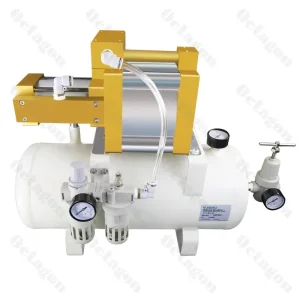
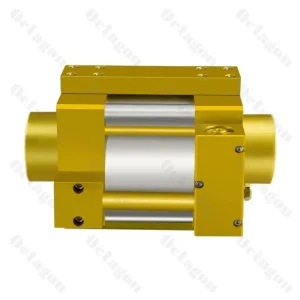
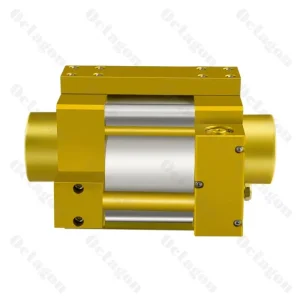
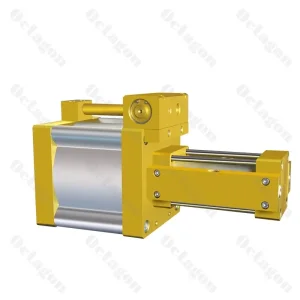
SWP series air and gas-liquid booster pumps amplify standard shop air (6 bar) up to 200–400 bar hydraulic pressure without electric motors.
Precision Micro-Cylinder
High-temperature in-mold cylinders drive hardened cutter inserts through gates while the resin remains at transition temperature.
Simultaneous Ejection
Parts and runner systems fall into separate conveyer chutes upon mold opening, completely eliminating secondary sorting labor.
What Global Procurement Teams Evaluate in Hanoi Tooling Partners
Multinational companies sourcing injection molds and automation fixtures from Vietnam apply strict vendor audits under ISO 9001 and IATF 16949. Sourcing teams prioritize partners who can demonstrate:
- Full Process Traceability: Certified steel origin (Assab, Daido, Finkl) with heat treatment documentation to prevent premature blade deformation under high-pressure cutting forces.
- Standardized Interchangeable Components: In-mold cutters, bushings, and seal kits designed to standard metric dimensional envelopes, allowing line technicians in Hanoi to replace wear parts in under 15 minutes.
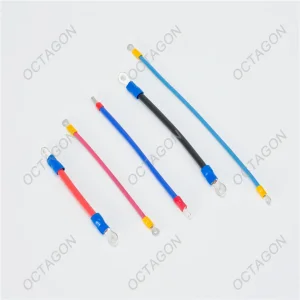
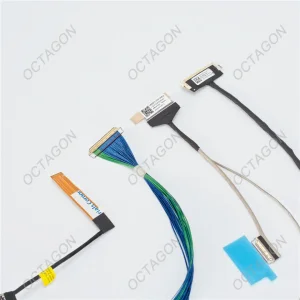
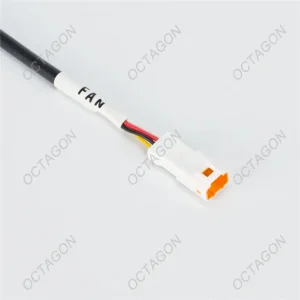
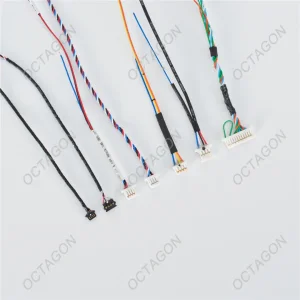
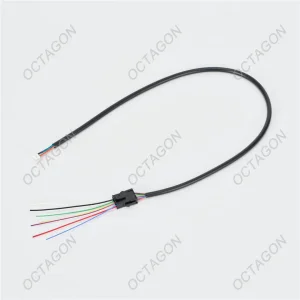
- Complete Pneumatic & Wiring Integration: Turnkey IP68-rated cable harnesses, CE-compliant cabinet wiring, and pre-calibrated pressure regulators that plug straight into existing press platforms (Sumitomo, Fanuc, Engel, KraussMaffei).
- Cycle Time Guarantees: Contractual verification of minimum cycle time reductions and gate vestige limits (typically < 0.05 mm) during mold trials.
Engineering Consultation Checklist
Ready to optimize your tooling line in Hanoi? Send our technical team your operational criteria for an immediate feasibility and cycle-time study:
- ✓ 3D CAD part model (STEP / X_T) & gating location
- ✓ Resin specifications, filler content (GF/CF %), and shrinkage rate
- ✓ Injection press tonnage and controller interface type
- ✓ Target cycle time and daily production quotas
Frequently Asked Questions on In-Mold Automation Solutions
Direct answers from our tooling and automation engineers on installation, compatibility, and maintenance.
How does an in-mold cutting automation system differ from robotic end-of-arm trimming?
Can this automation solution be retrofitted into existing injection molds in Hanoi factories?
What maintenance is required for in-mold cutting blades and pneumatic booster units?
What tolerance can Octagon achieve for precision mold inserts and automation components?
What is the average lead time for delivery to manufacturing plants in Hanoi?
High-Performance Booster Systems, Tooling & Cabling Solutions for Hanoi Exporters
Explore Octagon's certified booster pumps, custom harnesses, and precision mold components engineered for continuous industrial duty.